
European Bathroom Renovation Cost Index 2026
The headline number: construction labour costs 4.6× more in Denmark (€47.10/hour) than in Romania (€10.30/hour), the largest spread of the 18 EU countries we looked at. For a standard 6 m² bathroom renovation, that translates into a 1.84× total cost difference — €5,390 in Copenhagen vs €2,937 in Bucharest, mid-range tier. Almost the entire gap is labour.
Why this matters
The cost of renovating a bathroom is one of the most-Googled questions in home improvement, and the answer most calculator sites give is a single national number. We wanted to know how much that number actually changes when you cross an EU border.
The short answer: a lot, but only one part of your bill is doing the work.
Construction materials — tiles, sanitary ware, copper pipe, adhesive, grout, glazing — flow freely through the EU single market. A wholesale toilet from a German supplier costs roughly the same as the same toilet from a Polish supplier. But the labour that installs it is priced locally, by labour markets that look very different. A construction worker in Denmark costs an employer €47.10 per hour all-in (wages + payroll taxes + social contributions). The same worker in Romania costs €10.30. That spread is real, it is published by Eurostat every year, and it explains almost everything you see in the data below.
The full ranking
Standard 6 m² bathroom (3m × 2m), half-wall tiling, mid-range tier. Sorted from most expensive to cheapest. The full dataset including budget and luxury tiers is free to download as CSV.
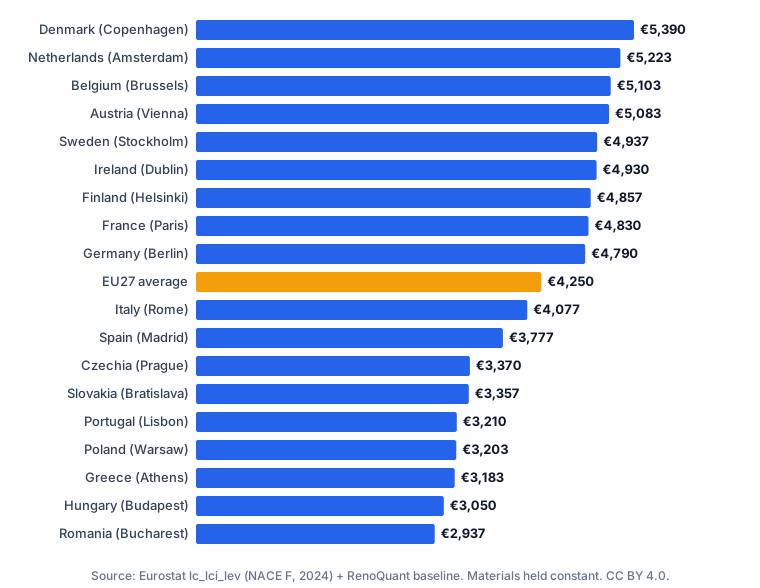
| Country | Capital | Labour cost (EUR/hour) | vs EU27 | Budget | Mid-range | Luxury |
|---|---|---|---|---|---|---|
| Denmark | Copenhagen | 47.10 | +57% | €2,963 | €5,390 | €10,853 |
| Netherlands | Amsterdam | 44.60 | +49% | €2,858 | €5,223 | €10,582 |
| Belgium | Brussels | 42.80 | +43% | €2,783 | €5,103 | €10,387 |
| Austria* | Vienna | 42.50 | +42% | €2,771 | €5,083 | €10,354 |
| Sweden | Stockholm | 40.30 | +34% | €2,679 | €4,937 | €10,116 |
| Ireland | Dublin | 40.20 | +34% | €2,675 | €4,930 | €10,105 |
| Finland* | Helsinki | 39.10 | +30% | €2,629 | €4,857 | €9,986 |
| France | Paris | 38.70 | +29% | €2,613 | €4,830 | €9,943 |
| Germany | Berlin | 38.10 | +27% | €2,588 | €4,790 | €9,878 |
| EU27 average | — | 30.00 | — | €2,250 | €4,250 | €9,000 |
| Italy | Rome | 27.40 | −9% | €2,142 | €4,077 | €8,718 |
| Spain | Madrid | 22.90 | −24% | €1,954 | €3,777 | €8,231 |
| Czechia | Prague | 16.80 | −44% | €1,700 | €3,370 | €7,570 |
| Slovakia | Bratislava | 16.60 | −45% | €1,692 | €3,357 | €7,548 |
| Portugal | Lisbon | 14.40 | −52% | €1,600 | €3,210 | €7,310 |
| Poland | Warsaw | 14.30 | −52% | €1,596 | €3,203 | €7,299 |
| Greece | Athens | 14.00 | −53% | €1,583 | €3,183 | €7,267 |
| Hungary | Budapest | 12.00 | −60% | €1,500 | €3,050 | €7,050 |
| Romania | Bucharest | 10.30 | −66% | €1,429 | €2,937 | €6,866 |
* 2024 labour cost values for Austria and Finland are flagged provisional by Eurostat.
What's actually driving the difference
It's almost entirely labour. A bathroom renovation is roughly 50% materials and 50% labour at the mid-range tier. Materials are largely the same across the EU thanks to the single market — a Grohe tap from a German wholesaler is priced similarly whether it ends up in Berlin or Athens, give or take freight and local VAT. What changes is the cost of the person installing it.
Employer payroll cost is more than twice the gross wage in many countries. When Eurostat reports a Belgian construction worker at €42.80/hour, that does not mean the worker earns €42.80/hour gross. The figure is the total cost to the employer: gross wages, plus employer-paid social contributions (pension, health, unemployment, accident insurance), plus payroll taxes. In countries like Belgium, France, and Austria, employer-side social charges can add 35–50% on top of the worker's gross wage. In Romania, Bulgaria and Hungary they are much lower in absolute terms, even adjusted for purchasing power.
The gap shrinks when you go small or premium. At the budget tier, materials are a smaller share of total cost (more of the bill is the labour to demolish, waterproof, and tile), so the country differential is wider. At the luxury tier, expensive fixtures make materials a larger share, narrowing the gap. This is why our budget-tier spread (€1,429 → €2,963 = 2.07×) is bigger than our luxury-tier spread (€6,866 → €10,853 = 1.58×).
How we calculated this
Costs in this analysis are derived from RenoQuant's national-average baseline for a 6 m² bathroom renovation (sourced from our bathroom renovation cost calculator, which itself aggregates ~50 hardcoded EUR cost points across our bathroom-related calculators) combined with Eurostat's published hourly labour cost in construction.
The country multiplier is calculated as country_labour_cost / EU27_labour_cost using Eurostat dataset lc_lci_lev, NACE Rev. 2 section F (Construction), labour cost structure D1_D4_MD5 (total labour cost: compensation of employees plus taxes minus subsidies), in EUR per hour, for the most recent published year (currently 2024). We then apply that multiplier only to the labour share of each tier — materials cost is held constant across the EU single market, which is a defensible simplification given that the wholesale price variation for the same construction product between EU member states is typically less than 10–15%, far smaller than the 4.6× spread in labour cost.
VAT is excluded from the v1 model. Standard VAT rates on renovation services vary across the EU (Germany 19%, France 20% standard / 10% reduced for certain renovation work, Italy 22% / 10%, Slovakia 23%), and several countries offer reduced rates specifically for energy-efficient renovation. Adding VAT would shift some of these numbers by another 5–10% and we will model it in v2.
The capital city of each country is used as a canonical reference in this article, but the underlying labour cost data is country-level — Eurostat does not publish city-level construction labour costs under a license that allows commercial republication. A reader in Munich should expect prices closer to the German national figure than to the Berlin figure specifically, since regional variation within Germany is its own (smaller) effect that this dataset does not capture.
The full underlying calculation is in the downloadable CSV. A skeptical reader following the methodology should arrive at the same numbers within ±€10 of rounding error.
Source: Eurostat, Labour cost levels by NACE Rev. 2 activity, dataset code
lc_lci_lev, NACE Rev. 2 section F, total labour cost (D1_D4_MD5) in EUR, 2024 estimates. Available from https://ec.europa.eu/eurostat/databrowser/view/lc_lci_lev/default/table?lang=en, accessed 2026-04-06. Licensed under Creative Commons Attribution 4.0 International (CC BY 4.0).
Annual update
This is the first edition of the RenoQuant European Bathroom Renovation Cost Index. We will republish in January 2027 with the most recent Eurostat data and a "what changed since 2026" section. Each annual release becomes a fresh news cycle for journalists tracking the cost of living across Europe. To be notified when the 2027 edition is out, subscribe via the form at the bottom of this page.
What this dataset deliberately excludes
- City-level data. We work with country-level labour costs because no free, license-compatible city-level dataset exists. Numbeo's city COL data is restricted to non-commercial use under their ToS.
- The United Kingdom. UK is no longer in Eurostat's dataset post-Brexit, and the UK ONS publishes construction price indices (relative trends since 2014, base year = 100) rather than absolute price levels, which would muddy the methodology. UK is a v2 expansion.
- Switzerland and Norway. EFTA countries are not always included in Eurostat's NACE F construction labour cost slice; excluded from v1 for clean methodology.
- VAT. Excluded from v1, as discussed in the methodology section above.
- Government grants and subsidies. Several countries offer renovation tax credits or grants (DE Bundesförderung, FR MaPrimeRénov, IE SEAI grants, IT Ecobonus). These are not deducted from the headline numbers because eligibility depends on household income, property type, and policy year.
See also
- Bathroom Renovation Calculator — material quantities and full cost for tile, adhesive, grout, and waterproofing, customisable to your bathroom size and tier, using the RenoQuant baseline in this study.
- Tile Calculator — for the tile portion of the bathroom budget specifically.
- Kitchen Renovation Cost Calculator — same methodology, different room.
RenoQuant Research is the data and analysis arm of RenoQuant, a free renovation calculator suite covering 18 trades across Europe. We aggregate cost data from public sources and our own calculator engines to help homeowners budget more accurately. If you're a journalist or researcher and you'd like the underlying data, the CSV is free under CC BY 4.0 — please credit "Eurostat + RenoQuant" if you use it.
Related tool: Bathroom Renovation Calculator →
Ready to calculate your project?
Get accurate material estimates and cost breakdowns in seconds.
Try the CalculatorGet Free Quotes
Connect with up to 3 local professionals. Free, no obligation.