
European Flooring Cost Index 2026
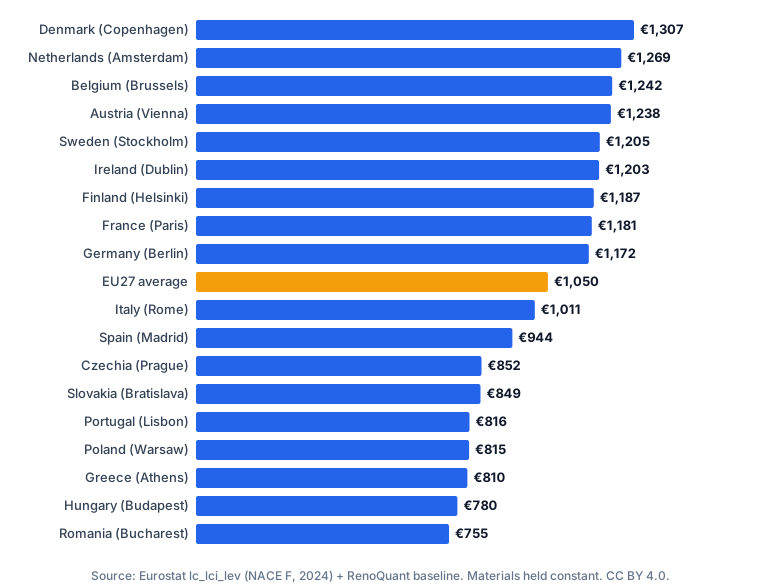
The headline number: professionally installing flooring in a 20 sqm room costs €1,307 in Copenhagen vs €755 in Bucharest at mid-range — a 1.73× spread. The absolute numbers are the smallest in our EU cost index series, but the relative gap is significant. And here's the kicker: DIY eliminates the labour component entirely, making flooring the one renovation where you can erase the country gap with a weekend of work.
Why this matters
Flooring is the most common renovation project in Europe. It's also the one where the DIY decision has the biggest relative impact on cost. Professional installation adds €15–35 per square metre across the EU — and for a click-lock laminate floor, the skill required to DIY is genuinely low.
That said, most homeowners hire a professional. And when you do, the installer's cost varies enormously depending on which EU country you're in. A flooring installer in Denmark costs an employer €47.10/hour; in Romania, €10.30/hour. For a straightforward 20 sqm room, that's the difference between a €450 labour bill and a €155 labour bill.
The materials — laminate planks, underlay, transition strips — cost essentially the same everywhere in the EU. A box of Egger or Kronospan laminate from a German manufacturer ships to every EU member state at similar pricing.
The full ranking
Standard 20 sqm living room, professionally installed mid-range laminate flooring. Sorted from most expensive to cheapest. The full dataset is free to download as CSV.
| Country | Capital | Labour cost (EUR/hour) | vs EU27 | Budget | Mid-range | Luxury |
|---|---|---|---|---|---|---|
| Denmark | Copenhagen | 47.10 | +57% | €978 | €1,307 | €2,064 |
| Netherlands | Amsterdam | 44.60 | +49% | €945 | €1,269 | €2,018 |
| Belgium | Brussels | 42.80 | +43% | €921 | €1,242 | €1,985 |
| Austria* | Vienna | 42.50 | +42% | €917 | €1,238 | €1,979 |
| Sweden | Stockholm | 40.30 | +34% | €887 | €1,205 | €1,939 |
| Ireland | Dublin | 40.20 | +34% | €886 | €1,203 | €1,937 |
| Finland* | Helsinki | 39.10 | +30% | €871 | €1,187 | €1,917 |
| France | Paris | 38.70 | +29% | €866 | €1,181 | €1,910 |
| Germany | Berlin | 38.10 | +27% | €858 | €1,172 | €1,899 |
| EU27 average | — | 30.00 | — | €750 | €1,050 | €1,750 |
| Italy | Rome | 27.40 | −9% | €715 | €1,011 | €1,702 |
| Spain | Madrid | 22.90 | −24% | €655 | €944 | €1,620 |
| Czechia | Prague | 16.80 | −44% | €574 | €852 | €1,508 |
| Slovakia | Bratislava | 16.60 | −45% | €571 | €849 | €1,504 |
| Portugal | Lisbon | 14.40 | −52% | €542 | €816 | €1,464 |
| Poland | Warsaw | 14.30 | −52% | €541 | €815 | €1,462 |
| Greece | Athens | 14.00 | −53% | €537 | €810 | €1,457 |
| Hungary | Budapest | 12.00 | −60% | €510 | €780 | €1,420 |
| Romania | Bucharest | 10.30 | −66% | €487 | €755 | €1,389 |
* 2024 labour cost values for Austria and Finland are flagged provisional by Eurostat.
What's actually driving the difference
Labour is roughly 43% of the mid-range total. That's a higher labour share than you might expect for what looks like a simple materials job. The reason: flooring installation includes subfloor preparation (levelling, moisture barrier), careful cutting around door frames and obstacles, and finishing work (skirting boards, transition strips). A professional does a 20 sqm room in 1–2 days.
The luxury tier amplifies the spread. Engineered hardwood (€35–80/m² in materials) requires more careful installation — acclimatisation, adhesive or nail-down methods, and sanding/finishing for unfinished boards. The labour share at the luxury tier (31%) is lower in percentage terms but higher in absolute hours, because the work is slower and more precise.
DIY is the great equaliser. Click-lock laminate and luxury vinyl plank (LVP) are designed for DIY installation. If you install the floor yourself, you pay only for materials — and materials cost nearly the same across the EU. A homeowner in Copenhagen who DIYs pays roughly €600 for materials; a homeowner in Bucharest pays the same €600. The €552 gap in our table (€1,307 vs €755) is pure labour savings.
Subfloor condition is the hidden variable. Our baseline assumes a level subfloor. If self-levelling compound is needed (€5–10/m² materials, €15–25/m² professional), it can add €300–500 to the bill — a significant chunk when the total project is under €1,500.
How we calculated this
Costs are derived from RenoQuant's national-average baseline for a 20 sqm flooring installation (sourced from our flooring cost calculator) combined with Eurostat's published hourly labour cost in construction.
The country multiplier is applied only to the labour share. Materials (laminate planks, underlay, transition strips, skirting) are held constant. Budget tier uses economy laminate (€12–20/m²), mid-range uses quality laminate (€20–35/m²), luxury uses engineered hardwood (€35–80/m²).
VAT excluded. Full methodology at EU renovation cost methodology.
Source: Eurostat, Labour cost levels by NACE Rev. 2 activity, dataset code
lc_lci_lev, NACE Rev. 2 section F, total labour cost (D1_D4_MD5) in EUR, 2024 estimates. Licensed under CC BY 4.0.
See also
- Flooring Calculator — material quantities and cost for any room size, including laminate and vinyl (LVP/sheet), using the RenoQuant baseline in this study.
- European Roofing Cost Index 2026 — same methodology, highest labour share of any trade.
RenoQuant Research is the data and analysis arm of RenoQuant, a free renovation calculator suite covering 18 trades across Europe. If you're a journalist or researcher, the CSV is free under CC BY 4.0 — please credit "Eurostat + RenoQuant" if you use it.
Related tool: Flooring Calculator →
Ready to calculate your project?
Get accurate material estimates and cost breakdowns in seconds.
Try the CalculatorGet Free Quotes
Connect with up to 3 local professionals. Free, no obligation.