
European Roofing Cost Index 2026
The headline number: a full re-roof costs €11,065 in Copenhagen vs €5,545 in Bucharest at the mid-range tier — a 2.00× spread, the widest of any renovation trade we've measured. Roofing is dangerous, skilled, physical work. The labour share is the highest of any residential renovation, and that makes it the most sensitive to where in Europe you live.
Why this matters
Roofing is the renovation category where labour costs hit hardest. Unlike a kitchen (where expensive cabinets absorb most of the budget) or solar panels (where the hardware is the majority), a re-roof is fundamentally a labour job. Someone has to climb scaffolding, strip the old roof, lay new membrane and battens, hang every tile, and flash every junction. The materials — concrete tiles, clay tiles, even slate — are relatively cheap per square metre compared to the skill and time needed to install them.
That's why the EU spread is so wide. When labour costs vary 4.6× across countries and labour makes up over 50% of the bill, the country you're in matters more than the material you choose.
The full ranking
Standard 70 sqm semi-detached house, full re-roof, mid-range clay tiles. Sorted from most expensive to cheapest. The full dataset including budget and luxury tiers is free to download as CSV.
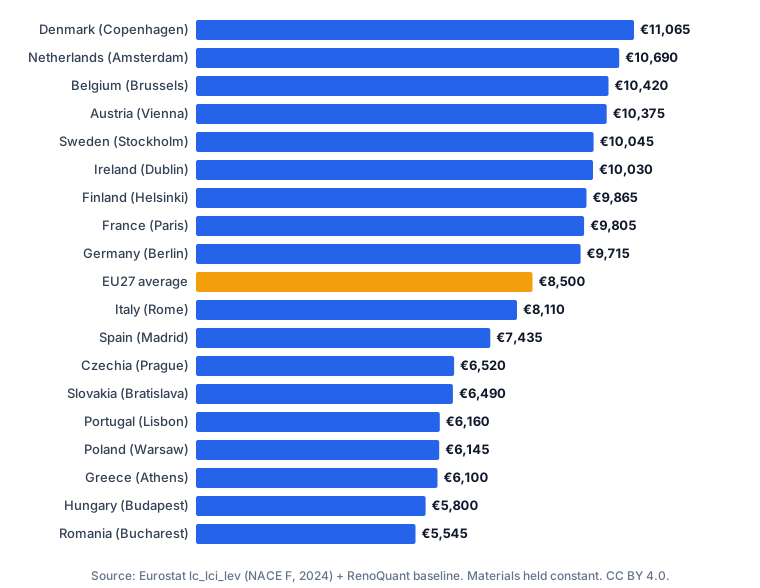
| Country | Capital | Labour cost (EUR/hour) | vs EU27 | Budget | Mid-range | Luxury |
|---|---|---|---|---|---|---|
| Denmark | Copenhagen | 47.10 | +57% | €7,995 | €11,065 | €15,135 |
| Netherlands | Amsterdam | 44.60 | +49% | €7,703 | €10,690 | €14,677 |
| Belgium | Brussels | 42.80 | +43% | €7,493 | €10,420 | €14,347 |
| Austria* | Vienna | 42.50 | +42% | €7,458 | €10,375 | €14,292 |
| Sweden | Stockholm | 40.30 | +34% | €7,202 | €10,045 | €13,888 |
| Ireland | Dublin | 40.20 | +34% | €7,190 | €10,030 | €13,870 |
| Finland* | Helsinki | 39.10 | +30% | €7,062 | €9,865 | €13,668 |
| France | Paris | 38.70 | +29% | €7,015 | €9,805 | €13,595 |
| Germany | Berlin | 38.10 | +27% | €6,945 | €9,715 | €13,485 |
| EU27 average | — | 30.00 | — | €6,000 | €8,500 | €12,000 |
| Italy | Rome | 27.40 | −9% | €5,697 | €8,110 | €11,523 |
| Spain | Madrid | 22.90 | −24% | €5,172 | €7,435 | €10,698 |
| Czechia | Prague | 16.80 | −44% | €4,460 | €6,520 | €9,580 |
| Slovakia | Bratislava | 16.60 | −45% | €4,437 | €6,490 | €9,543 |
| Portugal | Lisbon | 14.40 | −52% | €4,180 | €6,160 | €9,140 |
| Poland | Warsaw | 14.30 | −52% | €4,168 | €6,145 | €9,122 |
| Greece | Athens | 14.00 | −53% | €4,133 | €6,100 | €9,067 |
| Hungary | Budapest | 12.00 | −60% | €3,900 | €5,800 | €8,700 |
| Romania | Bucharest | 10.30 | −66% | €3,702 | €5,545 | €8,388 |
* 2024 labour cost values for Austria and Finland are flagged provisional by Eurostat.
What's actually driving the difference
Labour share is the highest of any renovation category. At the mid-range tier, approximately 53% of a re-roofing bill is labour and 47% is materials. At the budget tier (concrete tiles, the cheapest material option), labour exceeds 58%. This is why roofing shows the widest EU spread — more labour sensitivity means more country-to-country variation.
Roofing is dangerous work, and that commands a premium. Roofers work at height, in all weather, handling heavy materials. The skills are specialised (flashing, lead work, valley cutting), the safety requirements are strict (scaffolding is mandatory in every EU country), and the insurance costs are higher than for interior trades. In high-wage countries, these premiums compound.
Scaffolding adds a fixed cost floor. Scaffolding typically costs €600–1,500 per project regardless of tile material. We've included scaffolding in our materials baseline because it's a non-negotiable cost that doesn't vary with labour rates. This slightly compresses the spread at the budget end.
Material choice matters less than you'd expect. The difference between concrete tiles (€15–25/m²) and clay tiles (€30–50/m²) is modest compared to the labour cost of installing either. Choosing the cheapest tiles saves €1,000–2,000 on materials but doesn't change the €3,500–5,500 in labour. That's why our budget-to-luxury spread within a single country (e.g. Germany: €6,945 → €13,485) is wider than the cheapest-to-dearest country spread at mid-range tier (€5,545 → €11,065).
How we calculated this
Costs are derived from RenoQuant's national-average baseline for a 70 sqm full re-roof (sourced from our roofing cost calculator) combined with Eurostat's published hourly labour cost in construction.
The country multiplier is applied only to the labour share of each tier. Materials (tiles, membrane, battens, ridge, fixings, scaffolding) are held constant across the EU single market. Budget tier uses concrete interlocking tiles, mid-range uses clay tiles, and luxury uses natural slate.
VAT and government grants are excluded. The full methodology is documented in our EU renovation cost methodology.
Source: Eurostat, Labour cost levels by NACE Rev. 2 activity, dataset code
lc_lci_lev, NACE Rev. 2 section F, total labour cost (D1_D4_MD5) in EUR, 2024 estimates. Licensed under CC BY 4.0.
See also
- Roofing Calculator — tiles, membrane, battens, and full cost, using the RenoQuant baseline in this study.
- Roofing Material Guide — compare concrete, clay, slate, and metal options.
- Roof Pitch Calculator — calculate pitch angle and its effect on material requirements.
- European Bathroom Renovation Cost Index 2026 — same methodology, different trade.
RenoQuant Research is the data and analysis arm of RenoQuant, a free renovation calculator suite covering 18 trades across Europe. If you're a journalist or researcher, the CSV is free under CC BY 4.0 — please credit "Eurostat + RenoQuant" if you use it.
Related tool: Roofing Calculator →
Ready to calculate your project?
Get accurate material estimates and cost breakdowns in seconds.
Try the CalculatorGet Free Quotes
Connect with up to 3 local professionals. Free, no obligation.