
European Heat Pump Installation Cost Index 2026
The headline number: installing an 8–14 kW air source heat pump costs €14,565 in Copenhagen vs €9,045 in Bucharest at mid-range — a 1.61× pre-subsidy spread. But Ireland's €12,500 SEAI grant, Germany's BAFA scheme, Italy's 50% Ecobonus and Poland's Czyste Powietrze payments re-order the market completely. After national subsidies, Ireland is the cheapest country in Europe to install a heat pump (~€1,030 effective cost), and Germany halves from €13,215 to €6,615. Policy, not price, defines where the EU heat pump market is cheapest in 2026.
The ranking flips after subsidies
Almost every heat pump cost comparison we've seen tells only half the story: labour costs in northern Europe are 3–4× higher than in the east, so installation is "more expensive in Germany than in Poland." That's true before grants. But every major EU country now runs a heat pump subsidy scheme — and the grant amounts are large enough to fully re-rank the market.
Here is the same 8–14 kW air source heat pump installation, mid-range tier, before and after the typical national subsidy a middle-income homeowner qualifies for in 2026:
| Country | Pre-subsidy cost | Typical 2026 grant | Effective cost | Pre rank | Post rank | Δ |
|---|---|---|---|---|---|---|
| Netherlands | €14,190 | −€3,150 | €11,040 | 2 | 1 (most expensive) | +1 |
| Denmark | €14,565 | −€3,600 | €10,965 | 1 | 2 | −1 |
| Sweden | €13,545 | −€3,500 | €10,045 | 5 | 3 | −2 |
| Finland | €13,365 | −€4,000 | €9,365 | 7 | 4 | −3 |
| Belgium | €13,920 | −€5,500 | €8,420 | 3 | 5 | −2 |
| Spain | €10,935 | −€3,000 | €7,935 | 12 | 6 | +6 |
| France | €13,305 | −€6,500 | €6,805 | 8 | 7 | +1 |
| Germany | €13,215 | −€6,600 | €6,615 | 9 | 8 | +1 |
| Austria | €13,875 | −€7,500 | €6,375 | 4 | 9 | −5 |
| Italy* | €11,610 | −€5,805 | €5,805 | 11 | 10 | +1 |
| Greece | €9,600 | −€4,000 | €5,600 | 15 | 11 | +4 |
| Slovakia | €9,990 | −€4,500 | €5,490 | 13 | 12 | +1 |
| Romania | €9,045 | −€4,000 | €5,045 | 18 | 13 | +5 |
| Hungary | €9,300 | −€4,500 | €4,800 | 16 | 14 | +2 |
| Portugal | €9,660 | −€6,000 | €3,660 | 14 | 15 | −1 |
| Czechia | €10,020 | −€6,700 | €3,320 | 12 | 16 | −4 |
| Poland | €9,645 | −€7,000 | €2,645 | 16 | 17 | −1 |
| Ireland | €13,530 | −€12,500 | €1,030 | 6 | 18 (cheapest) | −12 |
* Italy's Ecobonus is a 50% tax credit recovered over 10 annual instalments, not a direct grant. Effective cost assumes the household can fully utilise the credit over the repayment window.
The headline movers:
- Ireland jumps 12 places — from 6th most expensive to cheapest in Europe, after SEAI raised the Heat Pump System grant to €12,500 in February 2026.
- Austria drops 5 places — from 4th most expensive before grants to 9th after, thanks to the new €7,500 Sanierungsoffensive cap.
- Denmark loses its "most expensive" title to the Netherlands, which has one of the stingiest heat pump grants in western Europe (fixed ~€3,150 for 8 kW under ISDE).
- Germany roughly halves its effective cost to €6,615 — still mid-pack, but cheaper than France after accounting for BAFA's 30% base + 20% speed bonus for fossil replacements.
Why this matters
The EU's REPowerEU plan and national phase-outs of fossil fuel heating are driving the fastest adoption of heat pumps in European history. Millions of homes across the continent will need to install one in the next decade. The question every homeowner asks first is: how much will it cost me?
The answer depends less on the heat pump itself — a Daikin, Vaillant, or Bosch unit costs roughly the same across Europe — and more on three things: who installs it, how complex the retrofit is, and most importantly, which country's subsidy scheme you qualify for.
In Denmark, construction labour costs an employer €47.10/hour. In Romania, €10.30/hour. The 4.6× labour gap is what generates the pre-subsidy spread. But subsidies swing €1,000 to €12,500 per household — easily enough to move your country 5–12 places up or down the ranking.
The 2026 heat pump subsidy landscape
Every EU country covered here has some form of residential heat pump support in 2026. Amounts reflect what a typical middle-income household replacing a fossil boiler qualifies for — not the theoretical maximum, which often requires special circumstances (lowest income tier, specific property types, regional top-ups).
| Country | Scheme | Typical 2026 grant | Mechanism & key conditions |
|---|---|---|---|
| Ireland | SEAI Heat Pump System | up to €12,500 | Raised Feb 2026: €6,500 heat pump + €2,000 heating upgrade + €4,000 fossil-swap bonus. Homes built before 2021. |
| Poland | Czyste Powietrze | avg PLN 50,500 (~€11,800) | Means-tested; basic tier PLN 66k, highest tier PLN 135k. Average award in 2025: PLN 50,500. |
| Austria | Sanierungsoffensive 2026 | up to €7,500 | 30% of cost cap. Requires replacement of oil/gas/coal heating. €360M federal budget. |
| Czechia | Nová zelená úsporám | up to 200,000 CZK (~€8,000) | Paused January 2026 pending new funding round; expected to resume mid-year via Modernisation Fund. |
| Germany | BAFA/BEG | 30% base, up to 70% | Max eligible cost €30k. Stacks: 30% base + 20% speed bonus (still-functioning fossil ≥20y) + 30% income bonus (<€40k taxable) + 5% natural-refrigerant efficiency. Speed bonus phases down after 2028. |
| France | MaPrimeRénov' + CEE | €3,000–€10,800 | Income-tiered MPR (€3k/4k/5k) combined with CEE certificates (~€5.8k). Cap €10,800 for very-modest households. Air-to-air excluded from 2026. Home must be ≥15 years old. |
| Italy | Ecobonus 2026 | 50% of cost | Primary residence only (36% for second homes); recovered as 10-year tax credit, max €30k deduction. Drops to 36% in 2027. Alternative: Conto Termico 3.0 with up to 65% direct reimbursement. |
| Belgium (Flanders) | Mijn VerbouwPremie | up to €8,000 | Up to 50% of invoice excl. VAT, income-tiered. Regional grants also exist in Wallonia and Brussels. Plus federal 6% VAT rate from 1 Jan 2026 for homes <10 years old (5-year window). |
| Hungary | Otthonfelújítási Program 2026 | HUF 1.25M–5M (~€3.3k–€13k) | Combined 50/50 loan + grant, HUF 2.5–10M total. Budapest and non-disadvantaged region applications suspended from 17 April 2026; rural areas continue. Requires ≥30% primary-energy savings. |
| Netherlands | ISDE | ~€3,150 (8 kW ASHP) | Fixed capacity-based formula: base amount + energy-label bonus. From 2026, split air-to-water units with <3kg refrigerant and GWP>750 are excluded. |
| Spain | IDAE / Next Gen EU aerothermal aid | €3,000 national + regional | €500/kW cap; regional top-ups in many autonomous communities add up to 30% of installation cost. Highly variable by region. |
| Greece | Exoikonomo 2026 + Social Climate Plan | €2,000–€5,760 | 50–60% of cost under Exoikonomo with no income criteria, plus a new €930M Social Climate Plan flat €2,000 replacement grant targeting 280,000 heat pump installs. |
| Portugal | E-Lar Programme | up to €15,000 per home | PAE+S replaced in 2026; E-Lar finances up to 100% of eligible whole-home energy-efficiency expenses. First phase exhausted in 6 days; €51.5M second tranche opened December 2025. |
| Slovakia | Zelená domácnostiam | up to 50% of cost | +15% uplift if replacing solid fuel or in managed-air-quality zone. €121M total budget. New 2026 conditions published Q2; vouchers issued Q3. Green Solidarity variant covers up to 90% for low-income. |
| Finland | ELY / ARA Energy Renovation Grant | €4,000 | Higher tier awarded when replacing with heat pump or district heating. Additionally 40–60% of installation labour is tax-deductible. |
| Romania | Casa Verde 2026 | 20,000 RON (~€4,000) | Compensation for portion of eligible costs. 2026 budget allocation ≈ RON 1 billion. |
| Denmark | Varmepumpepuljen 2026 | DKK 27,000 (~€3,600) | Fixed flat subsidy from 2026 (up from DKK 17,000 in 2025). Total pool DKK 116.9M — enough for ~4,300 households. Opened 5 Feb 2026. |
| Sweden | ROT deduction | 30% of labour + ~SEK 30,000 grant | ROT renovation deduction at 30% of labour cost (temporarily raised to 50% during 2025). Dedicated heat pump grant pool sunset mid-2025; replacement scheme status unclear. |
A note on modelling choice. The "typical grant" column above is the figure we use for the effective-cost calculation — representative of what a middle-income homeowner replacing a fossil boiler in a typical single-family home actually receives. Maximum theoretical grants (Germany's 70%, Poland's PLN 135k, Portugal's €15k) are reserved for special circumstances and would overstate the typical case. The full dataset with pre-subsidy, grant, effective cost, and source URLs is free to download as CSV under CC BY 4.0.
VAT: the third cost lever
Before subsidies even enter the picture, VAT treatment moves the headline cost by up to 4,000 euros between otherwise comparable countries:
| Country | Standard VAT | Heat pump VAT (2026) | Effect |
|---|---|---|---|
| France | 20% | 5.5% | Reduced rate for energy-saving work in homes >2 years old |
| Italy | 22% | 10% | Reduced rate for renovation services (on top of Ecobonus) |
| Ireland | 23% | 9% | Reduced rate for residential heat pump installation (since May 2023) |
| Poland | 23% | 8% | Reduced rate for heating systems in residential buildings ≤150 m² |
| Belgium | 21% | 6% (from 1 Jan 2026) | New 5-year reduced rate for homes <10 years old |
| Greece | 24% | 13% | Reduced rate for renovation services (labour portion) |
| Portugal | 23% | 6% (renewables) | Reduced rate for renewable heating equipment |
| Germany | 19% | 19% | No relief |
| Netherlands | 21% | 21% | No relief |
| Austria | 20% | 20% | No relief |
| Spain | 21% | 21% (labour: 10%) | Reduced rate on labour portion of renovation work |
| Denmark | 25% | 25% | No relief |
| Sweden | 25% | 25% | No relief — ROT labour deduction operates through income tax instead |
| Finland | 24% | 24% | No relief |
| Hungary | 27% | 27% | EU's highest standard VAT, no heat pump relief |
| Romania | 19% | 19% | No relief |
| Czechia | 21% | 12% | Reduced rate for residential construction works |
| Slovakia | 20% | 20% | No relief |
The tables above model pre-tax installed prices; gross prices paid by households stack VAT on top. A French installation at €13,305 pre-tax is €14,037 after 5.5% VAT — but the same installation in Germany (ignoring labour differences) would be €15,833 after 19% VAT. Combined with the €6,500 MaPrimeRénov' + CEE grant, the French net cost drops to roughly €7,537 gross — still lower than the German gross-net figure even after BAFA.
Why the EU spread is narrower for heat pumps than for painting
Heat pump installation is a hybrid project: part traded commodity (the unit itself — Daikin, Vaillant, Bosch all sell into a single EU market) and part local skilled labour (HVAC + plumbing + electrical commissioning, 2–4 days on site). That mix explains the 1.61× pre-subsidy spread — tighter than labour-heavy projects, wider than pure-commodity ones.
| Project type | Labour share | EU pre-subsidy spread | Why |
|---|---|---|---|
| Interior painting | ~80% | ~2.5× | Almost pure local labour; paint is a fraction of the bill |
| Roofing | ~65% | 2.00× | Skilled labour dominates, tiles partially commodity |
| Heat pump (ASHP) | ~37% | 1.61× | Unit is a traded commodity; installation is multi-trade labour |
| Double glazing | ~35% | ~1.5× | Frames are local manufacturing, glass is traded |
| Solar PV | ~25% | 1.37× | Panels and inverters are commodity; installation is fast |
This is why heat pumps don't rank in the same order as Eurostat's construction labour index. The €6,000–€8,000 "heat pump inside the box" is the same everywhere in the single market — it's the Daikin Altherma, the Vaillant aroTHERM, the Bosch Compress. What varies by country is the multi-trade labour above it, and then the subsidy cheque on top.
The full pre-subsidy table
Standard 8–14 kW air source heat pump, average home, mid-range tier. Sorted from most expensive to cheapest. Full dataset free to download as CSV.
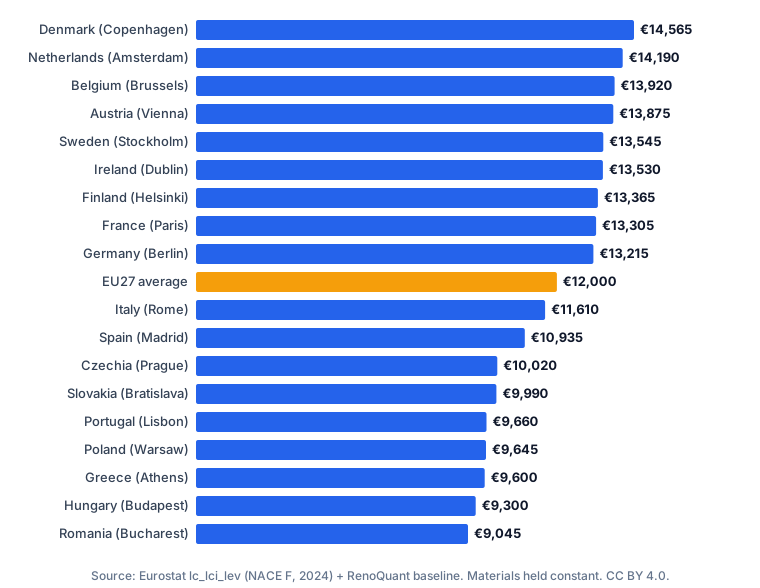
| Country | Capital | Labour cost (EUR/hour) | vs EU27 | Budget | Mid-range | Luxury |
|---|---|---|---|---|---|---|
| Denmark | Copenhagen | 47.10 | +57% | €11,280 | €14,565 | €19,420 |
| Netherlands | Amsterdam | 44.60 | +49% | €10,947 | €14,190 | €18,920 |
| Belgium | Brussels | 42.80 | +43% | €10,707 | €13,920 | €18,560 |
| Austria* | Vienna | 42.50 | +42% | €10,667 | €13,875 | €18,500 |
| Sweden | Stockholm | 40.30 | +34% | €10,373 | €13,545 | €18,060 |
| Ireland | Dublin | 40.20 | +34% | €10,360 | €13,530 | €18,040 |
| Finland* | Helsinki | 39.10 | +30% | €10,213 | €13,365 | €17,820 |
| France | Paris | 38.70 | +29% | €10,160 | €13,305 | €17,740 |
| Germany | Berlin | 38.10 | +27% | €10,080 | €13,215 | €17,620 |
| EU27 average | — | 30.00 | — | €9,000 | €12,000 | €16,000 |
| Italy | Rome | 27.40 | −9% | €8,653 | €11,610 | €15,480 |
| Spain | Madrid | 22.90 | −24% | €8,053 | €10,935 | €14,580 |
| Czechia | Prague | 16.80 | −44% | €7,240 | €10,020 | €13,360 |
| Slovakia | Bratislava | 16.60 | −45% | €7,213 | €9,990 | €13,320 |
| Portugal | Lisbon | 14.40 | −52% | €6,920 | €9,660 | €12,880 |
| Poland | Warsaw | 14.30 | −52% | €6,907 | €9,645 | €12,860 |
| Greece | Athens | 14.00 | −53% | €6,867 | €9,600 | €12,800 |
| Hungary | Budapest | 12.00 | −60% | €6,600 | €9,300 | €12,400 |
| Romania | Bucharest | 10.30 | −66% | €6,373 | €9,045 | €12,060 |
* 2024 labour cost values for Austria and Finland are flagged provisional by Eurostat.
What homeowners should take from this
Where you live matters less than the grants you can claim. The difference between claiming and not claiming your national scheme is frequently larger than the difference between installing in two "similar-cost" countries. Grant literacy — knowing which scheme applies, whether your property qualifies, which installer is on the approved list — is the single biggest cost lever available to a typical EU homeowner in 2026.
Install fast before schemes tighten. Several of the most generous programmes are explicitly time-limited:
- Italy's Ecobonus for primary residences drops from 50% to 36% in 2027, and to 30% for second homes.
- Germany's BAFA speed bonus (+20%) for replacing still-functional fossil heaters phases down after 2028.
- Austria's €360M federal budget for Sanierungsoffensive 2026 is finite — funds may be exhausted before year-end; regional top-ups have already hit caps in past cycles.
- Czechia's Nová zelená úsporám is currently paused and applications resume mid-2026 on new rules.
The "after subsidy" comparison tells you about policy, not the market. Pre-subsidy costs are a signal of where the market is most efficient (southern and eastern Europe are genuinely cheaper). Post-subsidy costs are a signal of where the government has decided to accelerate the transition (Ireland, Poland and Czechia are leaning in hardest; Netherlands, Denmark and Sweden are relying on labour-market signals rather than big grants).
How we calculated this
Pre-subsidy costs are derived from RenoQuant's national-average baseline for an 8–14 kW air source heat pump installation (sourced from our heat pump cost calculator) combined with Eurostat's published hourly labour cost in construction (NACE F, dataset lc_lci_lev, 2024 estimates). The country multiplier is applied only to the ~37% labour share; equipment (heat pump unit, pipework, controls, electrical components) is held constant across the EU single market. Budget tier uses a smaller 5–8 kW unit; mid-range uses an 8–14 kW unit; luxury uses a 14–20 kW unit with buffer tank and upgraded controls.
Subsidy amounts are compiled from official national scheme documentation as of April 2026 (sources linked in the table above). Values reflect a representative middle-income household replacing a fossil boiler in a typical single-family home — not the theoretical maximum, which requires special circumstances (lowest income tier, specific property types, regional top-ups). We have not modelled regional uplifts, income-tier variation, or fossil-swap bonuses in the headline figure; those are called out per-scheme in the subsidy table.
Caveats & exclusions:
- Ground source heat pumps excluded (borehole/trench costs are highly site-specific, typically 2× the ASHP figure).
- VAT is modelled separately; pre-subsidy and effective-cost tables show pre-tax prices.
- Italy's Ecobonus is treated as a 50% effective cost reduction, though mechanically it is a 10-year tax credit — households unable to fully utilise the credit over the window will see a smaller effective reduction.
- Grant amounts change regularly (Ireland raised SEAI in Feb 2026; Italy's Ecobonus drops in 2027; Czechia is paused). This report is a snapshot of April 2026.
Full technical details and the generation scripts are open source. Each CSV is published with a CC-BY-4.0 license — cite RenoQuant as the source and use the data freely. Full methodology at EU renovation cost methodology.
Sources: Eurostat, Labour cost levels by NACE Rev. 2 activity, dataset code
lc_lci_lev, NACE Rev. 2 section F, total labour cost (D1_D4_MD5) in EUR, 2024 estimates. National subsidy schemes linked in the subsidies table above. Licensed under CC BY 4.0.
See also
- Heat Pump Calculator — system size, install cost, and grants based on your home's heat loss, using the RenoQuant baseline in this study.
- Heat Pump vs Gas Boiler — head-to-head comparison of running costs and total cost of ownership.
- Heat Pump Guide — comprehensive guide to choosing and installing a heat pump.
- European Solar Panel Cost Index 2026 — the other EU energy transition trade.
RenoQuant Research is the data and analysis arm of RenoQuant, a free renovation calculator suite covering 18 trades across Europe. If you're a journalist or researcher, the CSV is free under CC BY 4.0 — please credit "Eurostat + RenoQuant" if you use it.
Related tool: heat-pump-calculator →
Ready to calculate your project?
Get accurate material estimates and cost breakdowns in seconds.
Try the CalculatorGet Free Quotes
Connect with up to 3 local professionals. Free, no obligation.