
European Solar Panel Installation Cost Index 2026
The headline number: a 4 kWp solar installation costs €7,312 in Copenhagen vs €5,349 in Bucharest pre-subsidy — a 1.37× spread, the narrowest of any renovation category in our EU index series. Hardware is ~75% of the bill and trades globally. But once you include 2026 national subsidies, the ranking shifts: Romania's Casa Verde grant pushes its effective cost to roughly €1,349, Greece drops to ~€2,047 after Fotovoltaika sto Stegi, and Germany's 0% VAT on residential PV — worth about €1,298 on an average system — is more valuable than most countries' direct grants.
The two stories on one chart
Solar is a different shape of problem from heat pumps. The hardware is genuinely commodity — panels, inverters, mounts, cables — priced on a single global market. That's why the pre-subsidy spread is only 1.37× (the narrowest in our EU index series). But the policy lever is just as decisive, and it comes in two flavours:
- Direct grants — Poland's Mój Prąd (€1,600 standalone, up to €3,800 with storage), Ireland's SEAI (€1,800), Czechia's Nová zelená úsporám (~€3,000), Greece's Fotovoltaika sto Stegi (€4,000–€10,000), Romania's Casa Verde (€4,000).
- VAT exemptions — Germany, Ireland and Austria have moved residential PV to 0% VAT (up to 30/35 kWp). Poland taxes it at 8%, Italy at 10%, France at 5.5% for systems ≤9 kWc, Belgium at 6% from January 2026.
The two mechanisms are economically equivalent for the household but look very different in the headline tables. A German buyer gets no cheque — but pays €1,298 less gross on a €6,832 system because VAT is zero. That beats the Irish SEAI grant at €1,800 only after accounting for Ireland's own 0% VAT.
Here is the same 4 kWp residential system, mid-range tier, before and after direct national subsidies (VAT treatment is shown separately below):
| Country | Pre-subsidy cost | Typical 2026 grant | Effective cost | Pre rank | Post rank | Δ |
|---|---|---|---|---|---|---|
| Denmark | €7,312 | €0 | €7,312 | 1 | 1 (most expensive) | 0 |
| Netherlands | €7,179 | €0 | €7,179 | 2 | 2 | 0 |
| Belgium | €7,083 | €0 | €7,083 | 3 | 3 | 0 |
| Germany | €6,832 | €0 (0% VAT, see below) | €6,832 | 9 | 4 | +5 |
| Finland | €6,885 | −€450 | €6,435 | 7 | 5 | +2 |
| Austria | €7,067 | −€640 | €6,427 | 4 | 6 | −2 |
| Sweden | €6,949 | −€700 | €6,249 | 5 | 7 | −2 |
| France | €6,864 | −€720 | €6,144 | 8 | 8 | 0 |
| Ireland | €6,944 | −€1,800 | €5,144 | 6 | 9 | −3 |
| Spain | €6,021 | −€1,800 | €4,221 | 11 | 10 | +1 |
| Portugal | €5,568 | −€1,500 | €4,068 | 14 | 11 | +3 |
| Poland | €5,563 | −€1,600 | €3,963 | 15 | 12 | +3 |
| Hungary | €5,440 | −€2,250 | €3,190 | 17 | 13 | +4 |
| Slovakia | €5,685 | −€2,500 | €3,185 | 13 | 14 | −1 |
| Italy* | €6,261 | −€3,130 | €3,131 | 10 | 15 | −5 |
| Czechia | €5,696 | −€3,000 | €2,696 | 12 | 16 | −4 |
| Greece | €5,547 | −€3,500 | €2,047 | 16 | 17 | −1 |
| Romania | €5,349 | −€4,000 | €1,349 | 18 | 18 (cheapest) | 0 |
* Italy's Ecobonus / Bonus Ristrutturazione for residential PV is a 50% tax credit spread over 10 annual instalments, not a direct grant. Effective cost assumes the household can fully utilise the credit over the repayment window.
The headline movers:
- Italy drops 5 places (10 → 15) — Bonus Ristrutturazione's 50% tax credit for residential PV is the single largest direct reduction in the EU, pushing effective cost below Slovakia despite Italy's higher labour costs.
- Germany rises 5 places (9 → 4) — but not because Germany got more expensive. Germany's "subsidy" is the 0% VAT on residential PV up to 30 kWp, which doesn't reduce the pre-VAT baseline in this table. Once gross prices are compared, Germany recovers most of those places (see the VAT section below).
- Hungary rises 4 places (17 → 13) — the Otthonfelújítási Program's grant isn't keeping pace with schemes in Czechia, Greece and Romania.
- Czechia drops 4 places (12 → 16) — Nová zelená úsporám bundled with battery support is one of the most aggressive schemes in the EU.
- Romania stays cheapest, but at less than a fifth of Denmark's cost — Casa Verde's flat 20,000 RON grant on a €5,349 system is a 75% effective discount.
The 2026 solar subsidy landscape
Every EU country covered here has some form of residential PV support in 2026 — a direct grant, a tax deduction, a VAT exemption, or a combination. Grant amounts reflect what a typical middle-income household with a 4 kWp system qualifies for — not the theoretical maximum.
| Country | Scheme | Typical 2026 grant (4 kWp) | Mechanism & key conditions |
|---|---|---|---|
| Romania | Casa Verde Fotovoltaice | ~€4,000 (20,000 RON) | Flat per-installation grant covering ~75% of a 4 kWp system. |
| Greece | Fotovoltaika sto Stegi | €3,500–€5,000 | 45%–75% of installation cost depending on income tier. €4,000–€10,000 range for combined PV + battery. |
| Italy | Bonus Ristrutturazione / Ecobonus 2026 | 50% of cost | Primary residence only (36% for second homes). 10-year tax credit, max €96k deduction base. PV is treated as a building renovation, not Ecobonus proper. |
| Czechia | Nová zelená úsporám | ~€3,000 (75,000 CZK) | +75,000 CZK for battery storage. Paused January 2026 pending Modernisation Fund refinancing; expected to resume mid-year. |
| Slovakia | Zelená domácnostiam | up to 50% of cost (~€2,500) | New 2026 conditions Q2; vouchers issued Q3. €121M total budget. |
| Hungary | Otthonfelújítási Program 2026 | ~€2,250 | Combined loan + grant; Budapest and non-disadvantaged regions suspended from 17 April 2026, rural areas continue. |
| Ireland | SEAI Solar Electricity Grant | €1,800 | €700/kWp for first 2 kWp + €200/kWp up to 4 kWp. Confirmed to remain €1,800 in 2026. Battery excluded. Homes built before 2021. |
| Spain | IRPF + Next Gen EU + regional | ~€1,800 | IRPF income-tax deduction up to 60% and IBI property-tax reductions (10–50% for 1–7 years) remain active through Dec 2026. New INEA/INCEA regional programmes Q1–Q2 2026. |
| Poland | Mój Prąd 6.0 | €1,400 standalone, €1,600 with battery | PLN 6,000 for PV only; PLN 7,000 with battery or heat storage; additional PLN 16,000 for qualifying electricity storage ≥2 kWh. |
| Portugal | E-Lar Programme / Fundo Ambiental | ~€1,500 (PV element) | Whole-home efficiency programme up to €15,000 per housing unit; PV is one of the eligible measures. Oversubscribed. |
| Sweden | Grön teknik (Green Technology) | ~€700 | 15% tax deduction on hardware + labour since July 2025 (was 20%). Max SEK 50,000 per person per year. |
| Austria | EAG Investitionszuschuss 2026 | €640 (4 kWp × €160) | Category A grant (≤10 kWp) at €160/kWp. +30% "Made-in-Europe" bonus if modules + inverter + storage are all EU-made. Storage €150/kWh. |
| France | Prime autoconsommation (Q2 2026) | €720 (4 kWp × €80/kWp from April 2026) | Reduced from €370/kWc (≤3 kWc) and €270/kWc (3–9 kWc) in Q1 2026. Paid as single lump sum at year 1 for ≤9 kWc systems. |
| Finland | Kotitalousvähennys | ~€450 | 60% tax deduction on labour portion of installation (labour is ~25% of bill). No dedicated PV direct grant. |
| Germany | 0% VAT up to 30 kWp + KfW 270 loan | €0 direct; ~€1,298 via 0% VAT | Since 2023, residential PV and batteries up to 30 kWp are exempt from 19% VAT — the largest de facto subsidy in the EU. EEG feed-in tariffs (6.2–8.2 c/kWh, 20-year guarantee) on top. |
| Netherlands | Salderingsregeling (ends 31 Dec 2026) | €0 upfront | 1:1 net metering still applies until Dec 2026; ends entirely Jan 2027. After that, compensation falls to 50% of consumption rate — battery economics shift dramatically. |
| Belgium (Flanders) | 6% VAT from Jan 2026 | €0 direct; ~€1,060 via 6% VAT | Federal 6% VAT on PV for homes <10 years old from 1 Jan 2026, 5-year window. Flemish Mijn VerbouwPremie no longer includes standalone PV after 2024. |
| Denmark | No dedicated residential PV grant | €0 | High retail electricity prices (~€0.45/kWh) and net metering drive payback without subsidy. Varmepumpepuljen covers heat pumps, not PV. |
VAT is the invisible subsidy
Solar is the renovation category where VAT differences are larger than most direct grants. Three countries have moved residential PV to 0% VAT since 2023, and several more apply substantially reduced rates:
| Country | Standard VAT | Solar PV VAT (2026) | VAT saving on €6,400 system |
|---|---|---|---|
| Germany | 19% | 0% (≤30 kWp) | ~€1,216 |
| Ireland | 23% | 0% (since 1 May 2023, residential) | ~€1,472 |
| Austria | 20% | 0% (since 1 Jan 2024, ≤35 kWp) | ~€1,280 |
| France | 20% | 5.5% (≤9 kWc, since 1 Oct 2025) | ~€928 vs standard rate |
| Belgium | 21% | 6% (homes <10y, from 1 Jan 2026) | ~€960 vs standard rate |
| Poland | 23% | 8% (residential ≤150 m²) | ~€960 vs standard rate |
| Italy | 22% | 10% | ~€768 vs standard rate |
| Czechia | 21% | 12% | ~€576 vs standard rate |
| Portugal | 23% | 6% (renewables) | ~€1,088 vs standard rate |
| Spain | 21% | 21% (labour at 10%) | small |
| Netherlands | 21% | 21% (reclaimable as producer) | small (paperwork) |
| Slovakia | 20% | 20% | — |
| Sweden | 25% | 25% (Grön teknik applies separately) | — |
| Denmark | 25% | 25% | — |
| Finland | 24% | 24% (kotitalousvähennys applies separately) | — |
| Hungary | 27% | 27% | — |
| Romania | 19% | 19% | — |
| Greece | 24% | 24% | — |
For the direct-grant ranking at the top of this article, we compare pre-VAT costs against direct grants only — matching the methodology of our other cost index reports. But in real life, a German household pays the gross price including VAT, and 0% VAT on a €6,832 system saves €1,298 up front. That is the largest residential PV subsidy in the EU, even though it appears nowhere in the grant column.
The combined picture (grant + VAT saving vs standard rate) materially changes a few rankings:
- Ireland combines €1,800 SEAI + 0% VAT = ~€3,272 total effective benefit on a €6,944 system, pushing gross effective cost to roughly €3,672.
- Germany pays full gross but 0% VAT = ~€1,298 effective benefit, gross effective cost ~€6,832.
- Italy 50% Ecobonus + 10% VAT (vs 22% standard) = ~€3,130 + €768 = ~€3,898 total benefit on a €6,261 system; gross effective cost closer to €3,000.
- France €720 grant + 5.5% VAT (vs 20% standard) = ~€1,648 total benefit on a €6,864 system; gross effective cost roughly €5,240.
Italy is the cheapest large-market EU country to install residential solar in 2026 once VAT and tax credits are both included. Germany becomes competitive with France despite having no direct grant scheme.
Why the EU spread is narrower for solar than for heat pumps
Solar panel installation is the most commodity-dominated project in our EU index series. Hardware is 75% of the bill, labour is 25%, and the hardware moves on a single global market:
| Project type | Labour share | EU pre-subsidy spread | Why |
|---|---|---|---|
| Interior painting | ~80% | ~2.5× | Almost pure local labour; paint is a fraction of the bill |
| Roofing | ~65% | 2.00× | Skilled labour dominates, tiles partially commodity |
| Heat pump (ASHP) | ~37% | 1.61× | Unit is a traded commodity; installation is multi-trade |
| Double glazing | ~35% | ~1.5× | Frames are local manufacturing, glass is traded |
| Solar PV | ~25% | 1.37× | Panels and inverters are global commodity; install is fast |
A residential 4 kWp installation is 1–2 days of work for a two-person crew. The electrician connecting the inverter and filing grid paperwork is the most specialised (and expensive) component of the labour share, but even that is a half-day task. Because the labour share is small, the 4.6× European labour-cost spread barely moves the headline number — it compresses to 1.37× at the total-cost level. That is the physical reason pre-subsidy solar rankings are flat: there is less local premium to charge.
Battery storage shifts the picture. Our baseline excludes home batteries. Adding a 5–10 kWh battery (€3,000–€6,000) would push the materials share higher and compress the EU spread below 1.2×. It would also significantly change the subsidy ranking — Germany's 0% VAT extends to batteries, Poland's Mój Prąd adds up to PLN 16,000 specifically for battery storage, and Austria's EAG subsidises storage at €150/kWh. Battery-inclusive analyses will appear in a future report.
The full pre-subsidy table
Standard 4 kWp residential system (10 panels), professionally installed, mid-range tier. Sorted from most expensive to cheapest. Full dataset free to download as CSV.
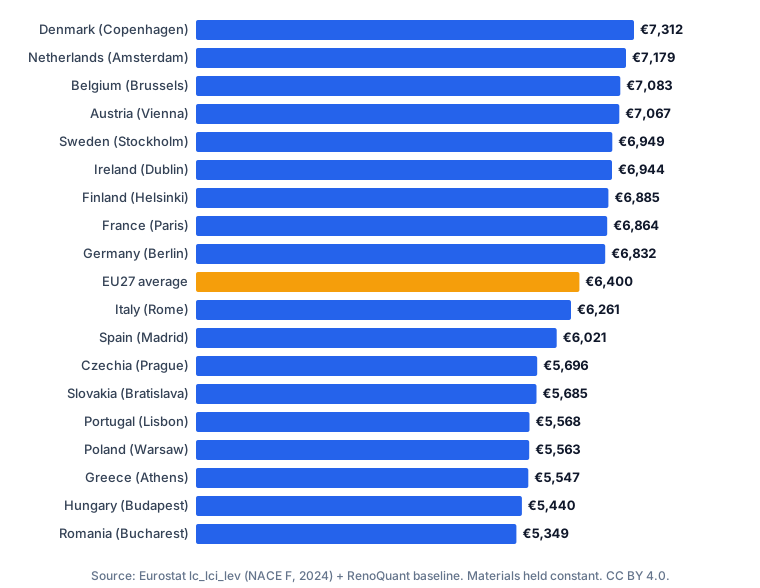
| Country | Capital | Labour cost (EUR/hour) | vs EU27 | Budget | Mid-range | Luxury |
|---|---|---|---|---|---|---|
| Denmark | Copenhagen | 47.10 | +57% | €5,684 | €7,312 | €9,326 |
| Netherlands | Amsterdam | 44.60 | +49% | €5,584 | €7,179 | €9,176 |
| Belgium | Brussels | 42.80 | +43% | €5,512 | €7,083 | €9,068 |
| Austria* | Vienna | 42.50 | +42% | €5,500 | €7,067 | €9,050 |
| Sweden | Stockholm | 40.30 | +34% | €5,412 | €6,949 | €8,918 |
| Ireland | Dublin | 40.20 | +34% | €5,408 | €6,944 | €8,912 |
| Finland* | Helsinki | 39.10 | +30% | €5,364 | €6,885 | €8,846 |
| France | Paris | 38.70 | +29% | €5,348 | €6,864 | €8,822 |
| Germany | Berlin | 38.10 | +27% | €5,324 | €6,832 | €8,786 |
| EU27 average | — | 30.00 | — | €5,000 | €6,400 | €8,300 |
| Italy | Rome | 27.40 | −9% | €4,896 | €6,261 | €8,144 |
| Spain | Madrid | 22.90 | −24% | €4,716 | €6,021 | €7,874 |
| Czechia | Prague | 16.80 | −44% | €4,472 | €5,696 | €7,508 |
| Slovakia | Bratislava | 16.60 | −45% | €4,464 | €5,685 | €7,496 |
| Portugal | Lisbon | 14.40 | −52% | €4,376 | €5,568 | €7,364 |
| Poland | Warsaw | 14.30 | −52% | €4,372 | €5,563 | €7,358 |
| Greece | Athens | 14.00 | −53% | €4,360 | €5,547 | €7,340 |
| Hungary | Budapest | 12.00 | −60% | €4,280 | €5,440 | €7,220 |
| Romania | Bucharest | 10.30 | −66% | €4,212 | €5,349 | €7,118 |
* 2024 labour cost values for Austria and Finland are flagged provisional by Eurostat.
What homeowners should take from this
VAT is as important as grants. For residential PV, the headline subsidy table misses the biggest lever in three of the EU's largest markets (Germany, Ireland, Austria) because 0% VAT doesn't look like a grant — it's just a lower invoice. If you're comparing across countries, always include both mechanisms.
Stack where you can. The best combinations in 2026 are Italy (50% tax credit + 10% VAT), Ireland (€1,800 SEAI + 0% VAT), Germany (0% VAT + KfW loan + 20-year EEG feed-in tariff), and Poland (€1,600 Mój Prąd + 8% VAT). These households pay an effective gross cost between €3,000 and €5,000 for a 4 kWp system that would cost €6,500 gross elsewhere.
Net metering is disappearing. The Netherlands' salderingsregeling ends 31 December 2026 — after that, solar becomes far less attractive without home battery storage. Households considering solar in the Netherlands should install before year-end or budget for batteries. Most other EU countries have already phased down net metering; feed-in tariffs are now the dominant policy (Germany's EEG, France's EDF OA).
Tax-credit mechanisms hide timing risk. Italy's 50% is recovered as a 10-year tax credit — households must have sufficient taxable income every year to actually claim it. Spain's IRPF deductions work similarly. Those mechanisms look like direct grants in the ranking but feel different in the bank account.
Policy inversions to watch:
- Italy's Ecobonus drops from 50% to 36% in 2027 for primary residences.
- France's Prime autoconsommation dropped sharply on 1 April 2026 — from €270/kWc (≤9 kWc) to €80/kWc. Install before March 31 applicants got dramatically more.
- Netherlands salderingsregeling ends 31 December 2026 — no phase-out, hard stop.
- Czechia's Nová zelená úsporám is currently paused and applications resume mid-2026 on new rules.
How we calculated this
Pre-subsidy costs are derived from RenoQuant's national-average baseline for a 4 kWp residential solar installation (sourced from our solar panel cost calculator) combined with Eurostat's published hourly labour cost in construction (NACE F, dataset lc_lci_lev, 2024 estimates). The country multiplier is applied only to the ~25% labour share; hardware (panels, inverter, mounting, wiring, scaffolding, AC isolator) is held constant across the EU single market. Budget tier uses economy panels and a string inverter; mid-range uses Tier 1 panels and a hybrid inverter; luxury uses premium panels with optimisers.
Subsidy amounts are compiled from official national scheme documentation as of April 2026 (sources linked in the table above). Values reflect a representative middle-income household installing a 4 kWp rooftop PV system in a typical single-family home. Where a country's main lever is a VAT reduction rather than a direct grant (Germany, Netherlands, Belgium from 2026), the grant column shows €0 and the mechanism is described in the VAT table.
Caveats & exclusions:
- Home battery storage excluded from baseline. Battery-inclusive installations would compress the pre-subsidy spread further and change the subsidy ranking (Poland and Germany in particular benefit).
- Italy's 50% treated as an effective cost reduction in the ranking, though mechanically it is a 10-year tax credit — households without sufficient taxable income cannot fully utilise it.
- Grant amounts change regularly (France's Prime autoconsommation dropped 70% in April 2026; Ireland's SEAI held at €1,800 for 2026; Czechia's NZÚ paused). This report is a snapshot of April 2026.
- Feed-in tariffs, net metering and self-consumption rates are not captured in the effective-cost figure — they affect payback period rather than up-front cost.
Full technical details and the generation scripts are open source. Each CSV is published with a CC-BY-4.0 license — cite RenoQuant as the source and use the data freely. Full methodology at EU renovation cost methodology.
Sources: Eurostat, Labour cost levels by NACE Rev. 2 activity, dataset code
lc_lci_lev, NACE Rev. 2 section F, total labour cost (D1_D4_MD5) in EUR, 2024 estimates. National subsidy schemes linked in the subsidies table above. Licensed under CC BY 4.0.
See also
- Solar Panel Calculator — size your system from roof and energy usage, and estimate generation, savings, payback, and 25-year ROI, using the RenoQuant baseline in this study.
- Solar Energy Guide — comprehensive guide to going solar in Europe.
- European Heat Pump Cost Index 2026 — the other EU energy transition trade, with the same subsidy-inversion analysis.
RenoQuant Research is the data and analysis arm of RenoQuant, a free renovation calculator suite covering 18 trades across Europe. If you're a journalist or researcher, the CSV is free under CC BY 4.0 — please credit "Eurostat + RenoQuant" if you use it.
Related tool: solar-panel-calculator →
Ready to calculate your project?
Get accurate material estimates and cost breakdowns in seconds.
Try the CalculatorGet Free Quotes
Connect with up to 3 local professionals. Free, no obligation.