
European Insulation Cost Index 2026
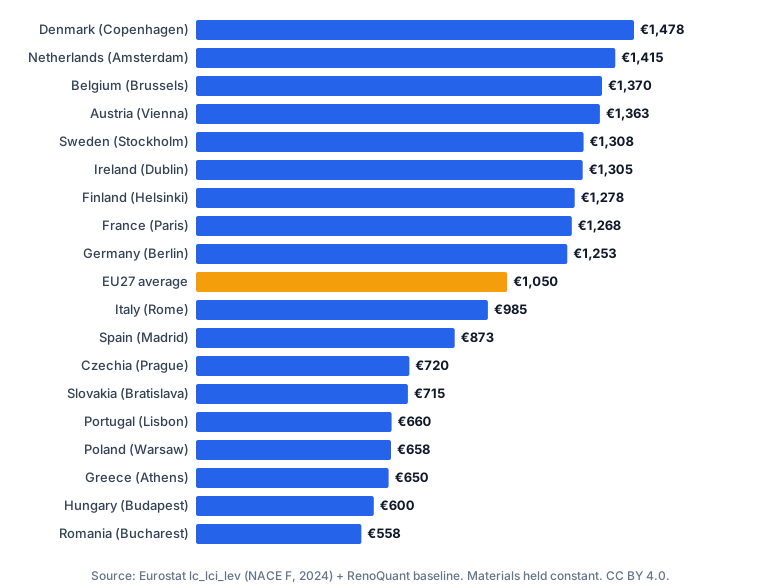
The headline number: professionally insulating a 50 sqm loft with 270mm mineral wool costs €1,478 in Copenhagen vs €558 in Bucharest at mid-range — a 2.65× spread. That's the second-widest gap in our EU cost index series, behind only painting (3.02×). The reason is the same: insulation is a labour-heavy trade with dirt-cheap materials. But unlike painting, insulation pays for itself — and it does so faster than almost any other home improvement.
Why this matters
Insulation has the second-highest labour share of any trade we track: roughly 71% of the mid-range total is labour. Mineral wool — the workhorse insulation material across Europe — costs €3–8 per square metre. For a 50 sqm loft, the materials bill is €200–500 depending on thickness and brand. The rest is someone crawling through your loft space for a day or two.
That high labour share creates a familiar dynamic: where you live determines most of the cost. An insulation installer in Denmark costs €47.10/hour; in Romania, €10.30/hour. For a job that takes 1–2 days, the labour bill ranges from under €250 to over €1,000.
But here's what makes insulation different from every other trade in this series: the investment pays for itself regardless of country. A properly insulated loft saves €200–600 per year in heating costs across northern and central Europe. Even in Denmark — where insulation costs the most — the payback period is typically 2–4 years. In Romania, it can be under 12 months.
This makes insulation the only renovation where the real question isn't "can I afford it?" but "should I hire a professional or do it myself?" And the answer depends heavily on your country's labour costs.
The full ranking
Standard 50 sqm loft insulation (mineral wool, 270mm thickness), professionally installed. Sorted from most expensive to cheapest. The full dataset is free to download as CSV.
| Country | Capital | Labour cost (EUR/hour) | vs EU27 | Budget | Mid-range | Luxury |
|---|---|---|---|---|---|---|
| Denmark | Copenhagen | 47.10 | +57% | €935 | €1,478 | €2,413 |
| Netherlands | Amsterdam | 44.60 | +49% | €893 | €1,415 | €2,308 |
| Belgium | Brussels | 42.80 | +43% | €863 | €1,370 | €2,233 |
| Austria* | Vienna | 42.50 | +42% | €858 | €1,363 | €2,221 |
| Sweden | Stockholm | 40.30 | +34% | €822 | €1,308 | €2,129 |
| Ireland | Dublin | 40.20 | +34% | €820 | €1,305 | €2,125 |
| Finland* | Helsinki | 39.10 | +30% | €802 | €1,278 | €2,079 |
| France | Paris | 38.70 | +29% | €795 | €1,268 | €2,063 |
| Germany | Berlin | 38.10 | +27% | €785 | €1,253 | €2,038 |
| EU27 average | — | 30.00 | — | €650 | €1,050 | €1,700 |
| Italy | Rome | 27.40 | −9% | €607 | €985 | €1,592 |
| Spain | Madrid | 22.90 | −24% | €532 | €873 | €1,404 |
| Czechia | Prague | 16.80 | −44% | €430 | €720 | €1,150 |
| Slovakia | Bratislava | 16.60 | −45% | €427 | €715 | €1,142 |
| Portugal | Lisbon | 14.40 | −52% | €390 | €660 | €1,050 |
| Poland | Warsaw | 14.30 | −52% | €388 | €658 | €1,046 |
| Greece | Athens | 14.00 | −53% | €383 | €650 | €1,033 |
| Hungary | Budapest | 12.00 | −60% | €350 | €600 | €950 |
| Romania | Bucharest | 10.30 | −66% | €322 | €558 | €879 |
* 2024 labour cost values for Austria and Finland are flagged provisional by Eurostat.
What's actually driving the difference
Labour is ~71% of the mid-range total — second only to painting. Mineral wool is extraordinarily cheap per square metre. The cost of insulating a loft is overwhelmingly the cost of someone spending a day laying it, ensuring no gaps around joists and pipes, and fitting a vapour barrier where required. The material itself accounts for €200–400 of the mid-range bill.
The 2.65× spread reflects that high labour share. When materials are cheap and labour is expensive, your country's position on the Eurostat labour cost table becomes the dominant variable. Denmark's mid-range cost (€1,478) is more than double Poland's (€658), almost entirely because of what installers are paid.
Energy payback makes the ROI calculation unique. A well-insulated loft saves €200–600/year in heating costs across most of Europe (more in Scandinavia and the Baltics, less in the Mediterranean). That means the payback period ranges from roughly 1 year in Romania to 3–4 years in Denmark. No other renovation — not a new kitchen, not new flooring, not a fresh coat of paint — generates a measurable financial return.
EU energy renovation subsidies complicate the picture further. Most EU member states offer grants or tax credits for insulation. Germany's BEG programme, France's MaPrimeRenov', Ireland's SEAI grants, and Poland's Clean Air programme can cover 30–70% of costs. When subsidies are factored in, professional insulation in some countries is effectively free — which makes DIY less attractive even in high-labour-cost countries.
Loft insulation is a reasonable DIY project. Unlike cavity wall or external insulation (which require specialist equipment and often building regulations approval), loft insulation with mineral wool rolls is within reach of most homeowners. The main barriers are access (small loft hatches), comfort (mineral wool fibres irritate skin), and knowledge of where to leave ventilation gaps. In countries where labour costs are high and subsidies don't cover the full bill — the Netherlands, Belgium, Sweden — DIY insulation offers the best return on a weekend's work.
The luxury tier tells a different story. Spray foam, PIR boards, or sheep's wool insulation cost 3–5× more than mineral wool per square metre, and some (spray foam) require specialist equipment. At the luxury tier, the materials share rises and the country spread narrows — but the absolute cost difference remains substantial: €2,413 in Denmark vs €879 in Romania.
How we calculated this
Costs are derived from RenoQuant's national-average baseline for a 50 sqm loft insulation project (sourced from our insulation cost calculator) combined with Eurostat's published hourly labour cost in construction.
The country multiplier is applied only to the labour share. Materials (mineral wool rolls, vapour barrier, tape, fixings) are held constant. Budget tier uses economy mineral wool (100–150mm), mid-range uses quality mineral wool (270mm, meeting current building regulations), luxury uses premium materials (spray foam, PIR boards, or natural fibre insulation at 300mm+).
VAT excluded. Full methodology at EU renovation cost methodology.
Source: Eurostat, Labour cost levels by NACE Rev. 2 activity, dataset code
lc_lci_lev, NACE Rev. 2 section F, total labour cost (D1_D4_MD5) in EUR, 2024 estimates. Licensed under CC BY 4.0.
See also
- Insulation Calculator — material quantities, loft depth, top-up layers, and full cost breakdown for any insulated area, using the RenoQuant baseline in this study.
- Insulation Types Guide — comparison of mineral wool, PIR, spray foam, and natural fibre insulation.
- European Heat Pump Cost Index 2026 — same methodology applied to heat pump installation — the natural companion investment to insulation.
RenoQuant Research is the data and analysis arm of RenoQuant, a free renovation calculator suite covering 18 trades across Europe. If you're a journalist or researcher, the CSV is free under CC BY 4.0 — please credit "Eurostat + RenoQuant" if you use it.
Related tool: Insulation Calculator →
Ready to calculate your project?
Get accurate material estimates and cost breakdowns in seconds.
Try the CalculatorGet Free Quotes
Connect with up to 3 local professionals. Free, no obligation.