
European Kitchen Renovation Cost Index 2026
The headline number: a full kitchen renovation costs €7,925 in Copenhagen vs €4,858 in Bucharest at the mid-range tier — a 1.63× spread driven almost entirely by labour. The gap is narrower than bathrooms (1.84×) because kitchens are materials-heavy: cabinets and appliances flow freely through the EU single market.
Why this matters
The kitchen is the most expensive room to renovate. Mid-range refits routinely hit €6,000–8,000 across northern Europe, and luxury projects can exceed €19,000. When homeowners search for "kitchen renovation cost," the answer they get is usually a single national average — which tells them almost nothing if they're comparing quotes in Milan vs Munich.
The reason: most of your kitchen budget goes to things — cabinets, worktops, appliances, tiles, taps. These are manufactured goods that trade freely across the EU. A German-made Nobilia kitchen costs roughly the same whether it's installed in Berlin or Lisbon. The difference between countries is the person who fits it, and that person's employer cost varies 4.6× across the EU.
But because materials make up a larger share of a kitchen refit (~60% at mid-range) compared to a bathroom (~50%), the country-to-country spread in total cost is narrower. Expensive cabinets are an equaliser.
The full ranking
Standard 12 sqm kitchen (4m × 3m), full refit with new cabinets, mid-range tier. Sorted from most expensive to cheapest. The full dataset including budget and luxury tiers is free to download as CSV.
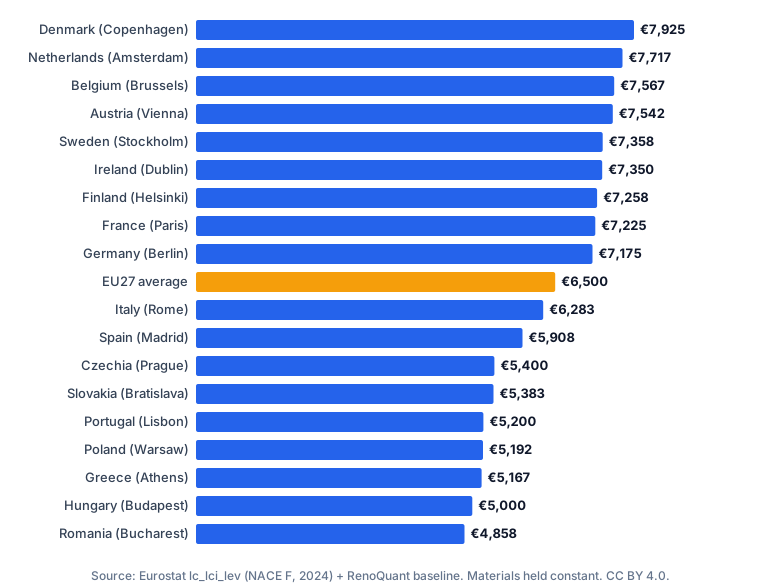
| Country | Capital | Labour cost (EUR/hour) | vs EU27 | Budget | Mid-range | Luxury |
|---|---|---|---|---|---|---|
| Denmark | Copenhagen | 47.10 | +57% | €2,456 | €7,925 | €19,850 |
| Netherlands | Amsterdam | 44.60 | +49% | €2,389 | €7,717 | €19,433 |
| Belgium | Brussels | 42.80 | +43% | €2,341 | €7,567 | €19,133 |
| Austria* | Vienna | 42.50 | +42% | €2,333 | €7,542 | €19,083 |
| Sweden | Stockholm | 40.30 | +34% | €2,275 | €7,358 | €18,717 |
| Ireland | Dublin | 40.20 | +34% | €2,272 | €7,350 | €18,700 |
| Finland* | Helsinki | 39.10 | +30% | €2,243 | €7,258 | €18,517 |
| France | Paris | 38.70 | +29% | €2,232 | €7,225 | €18,450 |
| Germany | Berlin | 38.10 | +27% | €2,216 | €7,175 | €18,350 |
| EU27 average | — | 30.00 | — | €2,000 | €6,500 | €17,000 |
| Italy | Rome | 27.40 | −9% | €1,931 | €6,283 | €16,567 |
| Spain | Madrid | 22.90 | −24% | €1,811 | €5,908 | €15,817 |
| Czechia | Prague | 16.80 | −44% | €1,648 | €5,400 | €14,800 |
| Slovakia | Bratislava | 16.60 | −45% | €1,643 | €5,383 | €14,767 |
| Portugal | Lisbon | 14.40 | −52% | €1,584 | €5,200 | €14,400 |
| Poland | Warsaw | 14.30 | −52% | €1,581 | €5,192 | €14,383 |
| Greece | Athens | 14.00 | −53% | €1,573 | €5,167 | €14,333 |
| Hungary | Budapest | 12.00 | −60% | €1,520 | €5,000 | €14,000 |
| Romania | Bucharest | 10.30 | −66% | €1,475 | €4,858 | €13,717 |
* 2024 labour cost values for Austria and Finland are flagged provisional by Eurostat.
What's actually driving the difference
Materials dominate, and that narrows the gap. A kitchen renovation at mid-range tier is roughly 60% materials (cabinets, worktops, appliances, tiles, plumbing fixtures) and 40% labour (strip-out, fitting, plumbing, electrical, tiling). Because the materials share is larger than in a bathroom renovation, the country-to-country price difference is smaller.
Cabinets are the great equaliser. A standard flat-pack kitchen from IKEA or a German manufacturer costs essentially the same across the EU. A €3,000 kitchen from Nobilia, Häcker, or Schüller ships to any EU country at similar wholesale pricing. The difference is the €200–400/day kitchen fitter installing it — and how many days that installation takes.
The luxury tier compresses the gap further. At the luxury tier, expensive appliances (Sub-Zero, Miele, Gaggenau) and premium surfaces (quartz worktops, natural stone) push materials to 70%+ of total cost. Our luxury-tier spread (€13,717 → €19,850 = 1.45×) is noticeably tighter than the budget-tier spread (€1,475 → €2,456 = 1.67×).
Labour complexity matters more than labour rate. A kitchen refit involves multiple trades — joiner, plumber, electrician, tiler — which is why the total labour cost is higher in absolute terms even though the labour share of the total is lower than for a bathroom. In countries with high labour costs, the multi-trade coordination premium amplifies the bill.
How we calculated this
Costs are derived from RenoQuant's national-average baseline for a 12 sqm kitchen renovation (sourced from our kitchen renovation cost calculator) combined with Eurostat's published hourly labour cost in construction.
The country multiplier is calculated as country_labour_cost / EU27_labour_cost using Eurostat dataset lc_lci_lev, NACE Rev. 2 section F (Construction), total labour cost (D1_D4_MD5), in EUR per hour, 2024. The multiplier is applied only to the labour share of each tier — materials cost is held constant across the EU single market.
VAT is excluded. Government grants for energy-efficient kitchen upgrades (e.g. induction hob subsidies in some countries) are excluded. The full methodology is documented in our EU renovation cost methodology and the CSV is free to download.
Source: Eurostat, Labour cost levels by NACE Rev. 2 activity, dataset code
lc_lci_lev, NACE Rev. 2 section F, total labour cost (D1_D4_MD5) in EUR, 2024 estimates. Licensed under CC BY 4.0.
See also
- Kitchen Renovation Calculator — full cost breakdown and material quantities for your kitchen project, using the RenoQuant baseline in this study.
- Kitchen Backsplash Calculator — tile quantity for the backsplash portion.
- Kitchen Layout Guide — planning guide before you commit to a budget.
- European Bathroom Renovation Cost Index 2026 — same methodology, different room.
RenoQuant Research is the data and analysis arm of RenoQuant, a free renovation calculator suite covering 18 trades across Europe. If you're a journalist or researcher, the CSV is free under CC BY 4.0 — please credit "Eurostat + RenoQuant" if you use it.
Related tool: Kitchen Renovation Calculator →
Ready to calculate your project?
Get accurate material estimates and cost breakdowns in seconds.
Try the CalculatorGet Free Quotes
Connect with up to 3 local professionals. Free, no obligation.