
European Fencing Cost Index 2026
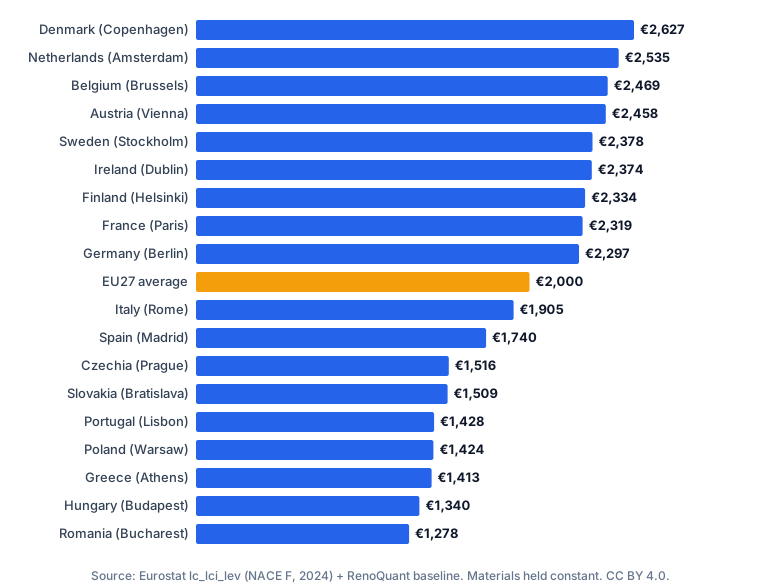
The headline number: a professionally installed 20 m closeboard fence costs €2,627 in Copenhagen vs €1,278 in Bucharest at mid-range — a 2.06x spread. Labour makes up ~55% of the total, and the biggest hidden cost variable isn't the country — it's the ground. Rocky or clay soil can add 20–30% to post hole costs alone. Fencing is also one of the most DIY-accessible trades, making it a strong candidate for eliminating the labour gap entirely.
Why this matters
Fencing is the most common "boundary" renovation in Europe, and it's often the first project a new homeowner takes on. Neighbours share costs. Planning permission is rarely needed for standard heights. And unlike a kitchen or bathroom, a fence is structurally simple — posts, rails, boards.
But simple doesn't mean cheap. A 20 m fence at 1.8 m height requires 8–10 concrete posts, each set in a 450 mm deep hole. A fencing contractor in Denmark costs €47.10/hour; in Romania, €10.30/hour. For a two-day installation job, that's roughly €750 in Danish labour versus €165 in Romanian labour.
The EU average sits at €2,000 for a mid-range closeboard fence — exactly €100 per linear metre installed. Germany comes in at €2,297, about 15% above the EU average, consistent with the pattern across all trades.
The full ranking
Standard 20 m run, 1.8 m high closeboard fence with concrete posts. Sorted from most expensive to cheapest. The full dataset is free to download as CSV.
| Country | Capital | Labour cost (EUR/hour) | vs EU27 | Budget | Mid-range | Luxury |
|---|---|---|---|---|---|---|
| Denmark | Copenhagen | 47.10 | +57% | €1,856 | €2,627 | €3,598 |
| Netherlands | Amsterdam | 44.60 | +49% | €1,789 | €2,535 | €3,481 |
| Belgium | Brussels | 42.80 | +43% | €1,741 | €2,469 | €3,397 |
| Austria* | Vienna | 42.50 | +42% | €1,733 | €2,458 | €3,383 |
| Sweden | Stockholm | 40.30 | +34% | €1,675 | €2,378 | €3,281 |
| Ireland | Dublin | 40.20 | +34% | €1,672 | €2,374 | €3,276 |
| Finland* | Helsinki | 39.10 | +30% | €1,643 | €2,334 | €3,225 |
| France | Paris | 38.70 | +29% | €1,632 | €2,319 | €3,206 |
| Germany | Berlin | 38.10 | +27% | €1,616 | €2,297 | €3,178 |
| EU27 average | — | 30.00 | — | €1,400 | €2,000 | €2,800 |
| Italy | Rome | 27.40 | −9% | €1,331 | €1,905 | €2,679 |
| Spain | Madrid | 22.90 | −24% | €1,211 | €1,740 | €2,469 |
| Czechia | Prague | 16.80 | −44% | €1,048 | €1,516 | €2,184 |
| Slovakia | Bratislava | 16.60 | −45% | €1,043 | €1,509 | €2,175 |
| Portugal | Lisbon | 14.40 | −52% | €984 | €1,428 | €2,072 |
| Poland | Warsaw | 14.30 | −52% | €981 | €1,424 | €2,067 |
| Greece | Athens | 14.00 | −53% | €973 | €1,413 | €2,053 |
| Hungary | Budapest | 12.00 | −60% | €920 | €1,340 | €1,960 |
| Romania | Bucharest | 10.30 | −66% | €875 | €1,278 | €1,881 |
* 2024 labour cost values for Austria and Finland are flagged provisional by Eurostat.
What's actually driving the difference
Labour is approximately 55% of the mid-range total. Fencing installation is surprisingly labour-heavy: digging post holes (by hand or with an auger), mixing and setting concrete, aligning posts with a string line, cutting rails to length, and nailing or screwing every board. A two-person crew typically completes 20 m in 1.5–2 days.
Ground conditions are the hidden cost multiplier. Our baseline assumes normal soil — easy to dig, no obstructions. But ground conditions vary enormously across Europe. Rocky soil in Ireland, heavy clay in the Netherlands, frost-susceptible ground in Scandinavia — all of these can add 20–30% to the post-setting portion of the job. In extreme cases (solid rock requiring breaker or core drilling), the cost of setting posts alone can exceed the materials bill.
DIY is genuinely accessible. Fencing is one of the few renovation trades where DIY is realistic for a motivated homeowner with basic tools. Pre-made fence panels reduce the skill requirement to: dig holes, set posts level, bolt on panels. If you DIY, you eliminate the labour gap entirely — a homeowner in Copenhagen pays the same materials cost as one in Bucharest. This makes fencing, alongside flooring, one of the strongest candidates for the "DIY equaliser" effect.
Neighbour cost-sharing changes the calculus. In most EU countries, boundary fences are shared costs between neighbours. This means the effective cost per household is often half the figures above. At €1,000 per household for a mid-range fence (EU average, shared), fencing is one of the cheapest renovation projects — which partly explains why it's so common.
How we calculated this
Costs are derived from RenoQuant's national-average baseline for a 20 m closeboard fence (sourced from our fence cost calculator) combined with Eurostat's published hourly labour cost in construction.
The country multiplier is applied only to the labour share. Materials (concrete posts, gravel boards, rails, closeboard featheredge, fixings, postcrete) are held constant across the EU single market. Budget tier uses pre-made panels, mid-range uses closeboard with concrete posts, luxury uses featheredge with trellis top and capping.
VAT excluded. Full methodology at EU renovation cost methodology.
Source: Eurostat, Labour cost levels by NACE Rev. 2 activity, dataset code
lc_lci_lev, NACE Rev. 2 section F, total labour cost (D1_D4_MD5) in EUR, 2024 estimates. Licensed under CC BY 4.0.
See also
- Fence Calculator — panels, posts, and materials plus full cost breakdown, using the RenoQuant baseline in this study.
- Fence Post Guide — choosing between concrete, timber, and steel posts.
- European Decking Cost Index 2026 — same methodology, the other major outdoor project.
- Concrete Calculator — calculate concrete volume and costs for post footings and other foundations.
RenoQuant Research is the data and analysis arm of RenoQuant, a free renovation calculator suite covering 18 trades across Europe. If you're a journalist or researcher, the CSV is free under CC BY 4.0 — please credit "Eurostat + RenoQuant" if you use it.
Related tool: Fence Calculator →
Ready to calculate your project?
Get accurate material estimates and cost breakdowns in seconds.
Try the CalculatorGet Free Quotes
Connect with up to 3 local professionals. Free, no obligation.